
Ed Sheeran successfully defended himself in a high profile US copyright trial in 2023 by arguing that the chord progression used in his hit song Thinking Out Loud was too common to be protected by copyright. During the trial, Sheeran took the stand with a guitar and demonstrated how similar chord patterns appear in numerous well known songs, supporting his legal team’s claim that basic musical building blocks cannot be owned.
The lawsuit centred on allegations that Thinking Out Loud copied elements of Let’s Get It On, the 1973 classic written by Marvin Gaye and Ed Townsend. The case was brought by the heirs of Townsend, who argued that the harmonic progression and rhythmic feel of Sheeran’s 2014 single infringed on the earlier composition.
According to reporting by BBC News, the core issue in the case was whether a shared four chord progression and similar tempo could constitute copyright infringement. Sheeran’s legal team argued that the chord sequence in question, often described as a I–iii–IV–V progression in the key of D, is widely used across pop and soul music.
Coverage from The Guardian confirmed that during the trial in New York federal court, Sheeran performed a live mashup of multiple songs using the same chord pattern. By playing snippets of tracks including his own material and well known classics, he demonstrated how common the structure is in modern songwriting.
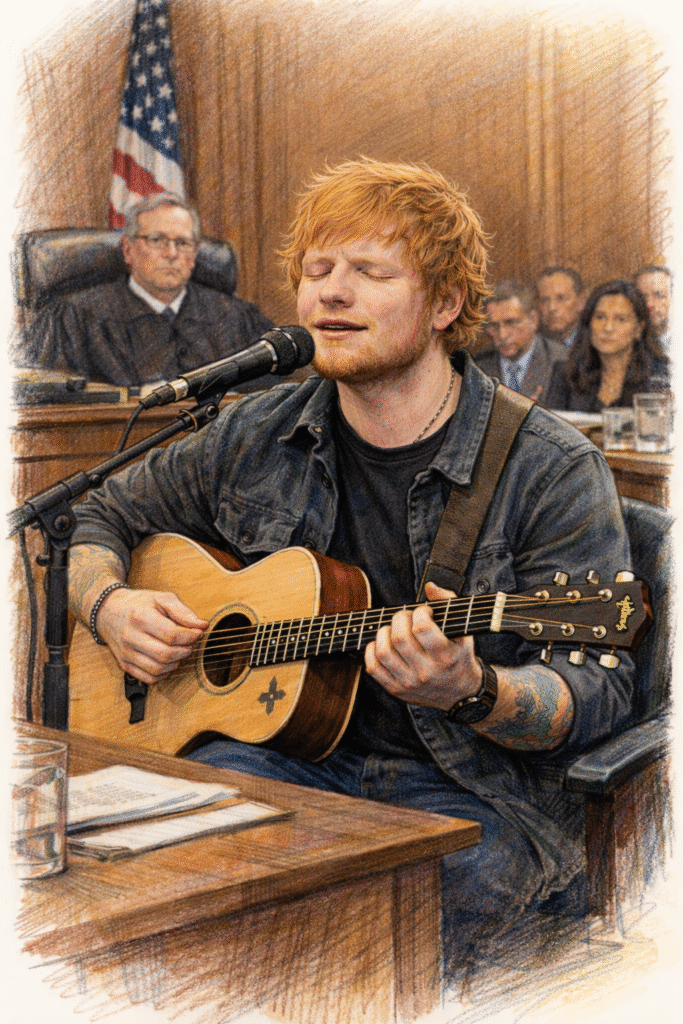
Reports in Rolling Stone detailed that Sheeran played a medley incorporating songs such as No Diggity and Let’s Get It On to show how similar harmonic foundations appear in numerous works without constituting copying. The performance was intended to illustrate that chord progressions alone are considered basic musical elements, not protected creative expression.
Legal analysis cited by Billboard explained that US copyright law protects original melody and lyrics, but not general chord structures or rhythmic grooves unless they are highly distinctive and original. Sheeran’s defence argued that granting ownership over a simple progression would restrict future songwriters from using fundamental musical tools.
After deliberation, the jury found that Sheeran had not infringed the copyright of Let’s Get It On. The verdict confirmed that the similarities identified by the plaintiffs were not substantial enough to constitute unlawful copying. Following the decision, Sheeran told reporters that he was pleased the court recognised the importance of protecting creative freedom in songwriting.

The case was closely followed across the music industry, as it raised broader concerns about the growing number of copyright lawsuits targeting chart songs based on structural similarities. Analysts noted that a ruling against Sheeran could have had significant implications for contemporary pop composition.
This was not the first time Sheeran had faced a copyright dispute. Previous cases relating to other songs were either settled or dismissed, but the Thinking Out Loud trial was considered the most high profile due to the legacy of Let’s Get It On and the prominence of Marvin Gaye’s catalogue.
The decision has since been referenced in ongoing discussions around music copyright standards and the distinction between inspiration and infringement. Industry observers cited by BBC News described the ruling as reinforcing the principle that common chord progressions remain part of the shared vocabulary of popular music.
More From Behind The Melody:
- Visit the Behind The Melody home page
- Explore music history in The Vault
- Browse daily history features in On This Day
About the Author