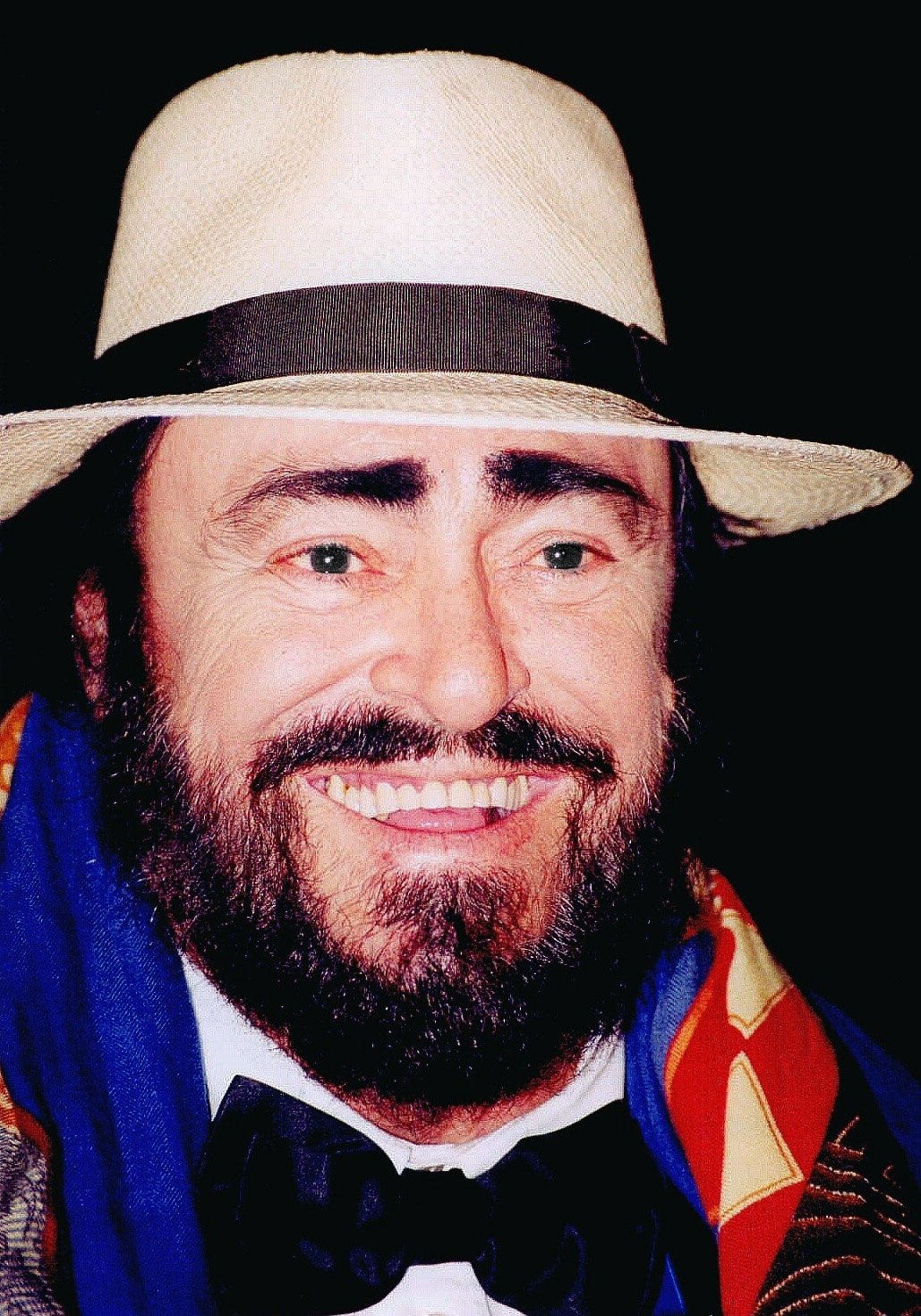
On 12 October 1935, Luciano Pavarotti was born in Modena, Italy. He would go on to become one of the most celebrated singers in music history, taking opera beyond the traditional concert hall and introducing it to millions of people around the world.
With his unmistakable tenor voice, extraordinary vocal range and commanding stage presence, Pavarotti became an international star whose popularity extended far beyond classical music.
His performances filled opera houses, concert halls and stadiums, while his recording of Nessun Dorma became one of the most recognisable classical performances of the modern era.
Yet his journey to international fame began in surprisingly modest circumstances.
A Childhood Surrounded by Music
Luciano Pavarotti was born into a working-class family in Modena, a city in northern Italy.
His father, Fernando Pavarotti, worked as a baker but possessed a fine tenor voice and regularly sang in a local church choir.
His mother, Adele Venturi, worked in a cigar factory.
The family had limited financial resources, and the Second World War brought further hardship during Pavarotti’s childhood.
Music, however, remained an important part of family life.
His father enjoyed listening to recordings of celebrated opera singers, introducing Luciano to performers including Beniamino Gigli, Tito Schipa and Giuseppe Di Stefano.
These recordings would help shape his early appreciation of singing.
As a young boy, Pavarotti began performing alongside his father in the local church choir.
Despite showing musical promise, becoming a professional singer was not initially his ambition.
He was passionate about football and considered pursuing a career as a goalkeeper.
Instead, he eventually trained as a schoolteacher, working in education for approximately two years before deciding to devote himself to music.
According to the Italian biographical reference Treccani, Pavarotti also worked in insurance while developing his singing career.
His professional breakthrough was still several years away.
The Beginning of an Extraordinary Career
Pavarotti began serious vocal training in the 1950s, studying with teachers including Arrigo Pola and Ettore Campogalliani.
His early years were devoted to developing the technique, breath control and musical understanding required of a professional opera singer.
In 1961, he won a singing competition in Reggio Emilia, Italy.
The victory opened the door to his first major operatic appearance.
On 29 April 1961, Pavarotti made his professional stage debut as Rodolfo in Giacomo Puccini’s La Bohème at the Teatro Municipale in Reggio Emilia.
The role would become one of the most important of his career.
Two years later, an unexpected opportunity helped establish his international reputation.
In 1963, Pavarotti was asked to replace the celebrated tenor Giuseppe Di Stefano in a production of La Bohème at London’s Royal Opera House, Covent Garden.
His performance attracted attention and introduced British audiences to a remarkable new voice.
Further international appearances followed as his reputation continued to grow.
By the late 1960s, Pavarotti was establishing himself as one of opera’s most exciting performers.
The Night That Made Opera History
One of the defining moments of Pavarotti’s career came in February 1972 at New York’s Metropolitan Opera.
He was performing the role of Tonio in Gaetano Donizetti’s La Fille du Régiment, an opera famous for placing extraordinary demands on its leading tenor.
The aria Ah! mes amis, particularly its concluding section Pour mon âme, requires the singer to deliver nine high C notes.
For a tenor, these notes represent a significant technical challenge, requiring exceptional control, strength and accuracy.
Pavarotti’s performance astonished the audience.
His ability to deliver the demanding notes with apparent ease helped establish his reputation as one of the finest tenors of his generation.
The audience responded with an extraordinary 17 curtain calls.
According to the Metropolitan Opera’s official archives, the production became a defining moment in his rise to international stardom.
The performance also helped establish the nickname that would follow him throughout his career.
The King of the High Cs.
From that point onwards, Pavarotti became one of the most sought-after performers in opera.
He would eventually appear in 378 performances at the Metropolitan Opera, performing 20 different roles.
His association with the institution continued for more than three decades.
The Voice That Captivated Audiences
What made Luciano Pavarotti extraordinary was not simply his ability to reach demanding high notes.
His voice possessed a distinctive combination of brightness, warmth and clarity.
His phrasing allowed him to communicate the emotional meaning of a piece even to listeners unfamiliar with the Italian language.
Unlike many classical performers whose audiences remained largely within the world of opera, Pavarotti developed a following that crossed musical boundaries.
His recordings introduced listeners to works by composers including Puccini, Verdi and Donizetti.
Among his most celebrated performances were O Sole Mio, La Donna è Mobile, Che Gelida Manina and Nessun Dorma.
His reputation also grew through television appearances and recordings, allowing people who had never attended an opera performance to experience his singing.
According to the Recording Academy, Pavarotti received five Grammy Awards during his career, alongside a Grammy Legend Award in 1998.
However, one particular performance would introduce his voice to an entirely new audience.
How the 1990 World Cup Changed Everything
In 1990, football and opera came together in a way few could have predicted.
The FIFA World Cup was being held in Italy, and the BBC selected Pavarotti’s recording of Nessun Dorma as the theme for its television coverage.
The aria comes from Giacomo Puccini’s opera Turandot.
Its title translates as None Shall Sleep, and its powerful conclusion became closely associated with the emotion and drama of the tournament.
For millions of British television viewers, the opening notes of Nessun Dorma became inseparable from memories of Italia ’90.
The tournament featured England’s dramatic journey to the semi-finals, Paul Gascoigne’s tears and some of the most memorable moments in modern football history.
Pavarotti’s voice provided the soundtrack.
The recording subsequently reached number two on the UK Singles Chart.
As recalled by BBC Sport, the music became one of the tournament’s most enduring cultural memories.
For many people, it was their first meaningful introduction to opera.
A recording that originated in the classical world had become a mainstream popular music success.
Pavarotti had achieved something remarkable.
He had helped make opera accessible to an audience that might never have considered listening to it.
The Three Tenors
The success of Italia ‘90 coincided with another defining moment in Pavarotti’s career.
On 7 July 1990, he joined fellow tenors Plácido Domingo and José Carreras for a concert at the ancient Baths of Caracalla in Rome.
Conducted by Zubin Mehta, the performance brought together three of the world’s most celebrated operatic voices.
The event became known as The Three Tenors.
The concert combined traditional operatic arias with popular songs, allowing the performers to demonstrate their individual talents while celebrating their shared musical heritage.
Its success exceeded expectations.
The recording became the best-selling classical album of all time, according to Decca Records.
The Three Tenors subsequently performed together at further major international events, including concerts associated with later World Cup tournaments.
Their performances attracted audiences far beyond the established classical music community.
For Pavarotti, the project reinforced his position as one of the world’s most recognisable musical figures.
It also demonstrated that classical singing could command the same international attention as major popular music events.
Bringing Opera and Popular Music Together
Pavarotti’s willingness to collaborate with musicians outside opera became another important part of his career.
In 1992, he launched the Pavarotti & Friends concert series in his hometown of Modena.
The concerts brought together leading figures from classical music, rock and pop.
Over the years, participating artists included Bono, Sting, Elton John, Eric Clapton, Lionel Richie and members of Queen.
These collaborations introduced Pavarotti to younger audiences while raising money for humanitarian causes.
One of his best-known collaborations was with U2 on Miss Sarajevo, a song associated with the suffering caused by the Bosnian War.
The recording demonstrated how his operatic voice could be incorporated into contemporary popular music without losing its distinctive character.
Rather than treating opera and popular music as entirely separate worlds, Pavarotti helped bring them together.
His collaborations also carried a humanitarian purpose.
According to the United Nations Refugee Agency, the 2003 Pavarotti & Friends concert raised more than €2 million to support Iraqi refugees.
The event featured artists from several musical genres and attracted international attention.
For Pavarotti, music had become a way of supporting people facing hardship.
A Humanitarian Beyond the Stage
Throughout his later career, Pavarotti devoted considerable time to charitable work.
His fundraising concerts supported refugees and communities affected by conflict.
He became closely associated with the United Nations Refugee Agency, using his international reputation to raise awareness and financial support.
In 2001, he received the Nansen Refugee Award in recognition of his humanitarian contributions.
The award acknowledged his efforts to assist displaced people around the world.
Following his death, UNHCR confirmed that his concerts and related fundraising activities had generated more than $7 million for refugee projects.
His work supported humanitarian programmes in Kosovo, Afghanistan, Angola and Iraq.
Pavarotti’s legacy therefore extended beyond his achievements as a performer.
His fame had provided an opportunity to make a difference in the lives of people far removed from the opera stage.
His Final Years
By the early 2000s, Pavarotti had begun reducing his operatic commitments.
His final appearance at New York’s Metropolitan Opera took place on 13 March 2004, when he performed the role of Cavaradossi in Puccini’s Tosca.
The occasion marked the end of an extraordinary association with one of the world’s most prestigious opera houses.
According to the Metropolitan Opera, the performance was met with an emotional response from the audience.
Despite increasing health difficulties, Pavarotti continued to perform.
In February 2006, he appeared at the opening ceremony of the Winter Olympic Games in Turin, Italy.
Performing Nessun Dorma, he delivered what would become his final public performance.
Later that year, Pavarotti was diagnosed with pancreatic cancer.
He underwent surgery and received treatment, but his health continued to deteriorate.
On 6 September 2007, Luciano Pavarotti died at his home in Modena.
He was 71 years old.
The singer who had introduced opera to millions had returned to the city where his remarkable life began.
A Legacy That Continues
Luciano Pavarotti remains one of the most influential figures in the history of classical music.
His extraordinary voice, charismatic personality and willingness to embrace new audiences helped transform the public image of opera.
Through recordings, television appearances, international concerts and collaborations with popular musicians, he demonstrated that classical music could connect with people regardless of their musical background.
His performances of Nessun Dorma remain particularly significant.
For some listeners, the aria represents the emotional intensity of Puccini’s Turandot.
For others, it recalls the unforgettable summer of the 1990 World Cup.
Both associations demonstrate the extraordinary reach of Pavarotti’s music.
His career also helped create opportunities for future classical performers seeking to reach wider audiences.
The success of the Three Tenors showed that opera could attract enormous international audiences, while Pavarotti & Friends demonstrated how classical and contemporary musicians could collaborate successfully.
His humanitarian achievements remain another important part of his story.
Through his music, he raised millions for people affected by war and displacement.
Remembering Luciano Pavarotti
On 12 October 1935, Luciano Pavarotti was born into a modest family in northern Italy.
He began life surrounded by the music his father loved, with little indication that he would eventually become one of the world’s most recognisable singers.
From his early performances in local choirs to the world’s greatest opera houses, his career was defined by an exceptional voice and a determination to share music with as many people as possible.
His performances brought opera into living rooms, football stadiums and popular culture.
For millions, he became the voice of Nessun Dorma.
For others, he remains the tenor whose recordings opened the door to an entirely new world of music.
Luciano Pavarotti, 12 October 1935 to 6 September 2007.
Sources
This article was researched using the following sources:
- Metropolitan Opera: Pavarotti at the Met
- Recording Academy: Luciano Pavarotti
- Treccani: Luciano Pavarotti Biography
- BBC Sport: Memories of Italia ’90
- Decca Records: The Original Three Tenors Concert
- UNHCR: Remembering Luciano Pavarotti
- UNHCR: Pavarotti & Friends Charity Concert
More from Behind the Melody
Discover more stories about the artists, recordings and events that shaped music history.
Explore On This Day, discover more stories in The Vault, or read the latest Music Industry News.
Visit Behind the Melody for more music history and artist stories.
Follow Behind the Melody
YouTube | TikTok | Instagram | Facebook
About the Author